Sight unseen might not be the best advice for conquering a strange and mysterious place, but it worked just fine last year for Dr. Ronald Tang.
“I’ve never been to Kentucky Downs,” he said.
Yet this doctor of oncology nearly 2,000 miles away in South Pasadena, Calif., won the 2024 King of the Turf Challenge handicapping contest which zeroes in on the Kentucky-Tennessee border’s hilly turf course.
Click here for Kentucky Downs entries and results.
Tang defends his title when the live-money, online contest is renewed Saturday, weather permitting, for the big-money card which includes the Grade 2, $2.5 million Kentucky Turf Cup.
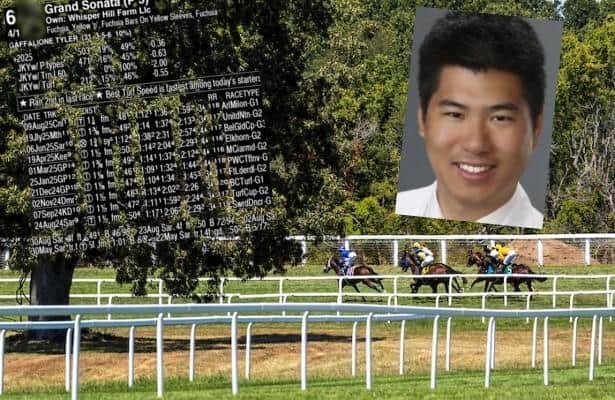
When Grand Sonata won that race last year, Tang had him at 15-1, turning his lead into a runaway that came with a $33,450 first prize. He knows good and well, though, he will not get those odds this weekend. At the 4-1 morning-line favorite, Mandy Pope’s homebred 6-year-old horse trained by Todd Pletcher does not necessarily have a place on Tang’s ticket this time around.
“We’ll have to see,” he said by phone as he was driving in Southern California this week. “That horse has a special place in my heart, but if he’s bet down to 6-5, and I see other value, I might have to pass on him.”
Calling himself a retail player who uses some computer software, Tang said he most certainly is not a batch bettor. He does not wager enough to merit track rebates, so he still is more of a grinder of a horseplayer.
He lives near Santa Anita, but this weekend Tang breathes Kentucky Downs. He shared some of his strategy in an interview shown in edited form. The entire conversation may be heard on Horse Racing Nation’s Ron Flatter Racing Pod.
Kentucky Downs is such a mystery for so many bettors simply because of its layout. There’s nothing like it in the United States. How do you go about it?
“It’s a very unique track, and it’s a very boutique meet and only runs seven days a year, so it’s hard to even look at past performances and things from that standpoint. These little tricks are pearls that I’ve picked up. The track is unique in the sense that even though sometimes it lists seven furlongs, I think it actually runs longer than that seven furlongs because of its undulations and hills and turns. How I use that to my advantage is that I actually like horses that tend to go longer, and I use those. Instead of seven furlongs, I kind of in my mind think of it as a 7.2-furlong race. I tend to go to horses that have run longer, and actually the cutback is not a true cutback for them, if that make sense. That’s the same thing on the route course as well.”
Do you look at races that take place on similar courses in Europe and those horses coming over here in any way as a template for your betting?
“Absolutely. If a Euro decides to make its first start in America at Kentucky Downs, that really raises my eyebrows. Especially when the odds open, and it starts taking some money, that definitely means something from my standpoint. Euros tend to run better here, because obviously their tracks have undulations and turns kind of like Kentucky Downs as well. Horses that have done well at Kentucky Downs previously tend to do well again. A horses-for-courses type of thing. It’s hard to see that in past performances as it only runs once a year.”
This isn’t exactly secret sauce that you’re describing, though. Do you watch the toteboard for a particular direction that the horses are going? Or do you go beyond that and use other handicapping tools to put into your thinking?
“Some of the basic tools that I talked about are more key to this track than others. Obviously, the trainer-jockey combination I think is really key here, because certain trainers just tend to do well here. Obviously Michael Maker, and if an Ortiz brother gets on, you kind of have to see it. But even if those are obvious, I’ve seen José Ortiz go off on this track at 8-1 and 10-1.
“It’s hard to make a good morning line for this track compared to others. Morning-line makers have a tough job to begin with, but especially with this track since it only runs seven or eight days, that morning line can’t be that accurate. If people are confused, even bettors that are experienced are trying to make a judgment call there. The morning lines generally could be a little bit off. So if I see a 12-1 horse suddenly open up at 3-1, that tends to raise my eyebrow a little bit. I try to look for a price, too. I tend to look for overlays from that standpoint.
“You probably have to use some sort of computer or AI tool nowadays, because if you’re just using pen and paper, you’re bringing a knife to a gunfight. That’s what I compare it to. I would say more than 50-60% of the players may use some type of computer tool or AI tool. For me I don’t completely depend on it, but I do use at times Scotty McKeever’s EquinEdge sometimes just to see if something on there matches my handicapping. I kind of use it in tandem to try to make a decision on what horses I’d like to bet.”
As you mentioned, though, this is not a huge sample size with Kentucky Downs. When you’re applying some of these optics, does it really just become a numbers game no different than any other track, or do you find that there are more risks and flaws because of the small sample size?
“Obviously with the data such as a bigger track like Saratoga or Del Mar, those things can be more accurate. With this parity, you can actually use it to your advantage. If you see something on pen and paper that is for example an overlay, and you see it on the program as kind of iffy or may support it a little bit, that really is a horse I home in on a la Grand Sonata last year.”
Do you use computer programs for other tracks? And what other tracks do you play more often?
“I do use the computer program for other tracks. I usually play the bigger tracks, the more popular tracks. This summer I did play a little bit of Saratoga and Del Mar. Obviously, like other players focused on the summer and then during the regular season, I do play more East Coast tracks such as Aqueduct, and when Belmont was open at that time, I would do those. Even though I live on the West Coast, Santa Anita is my home track, but unfortunately with its field sizes these days, it’s hard to actually get good value, so I kind of pick and choose. That’s another reason why I like playing Kentucky Downs for these seven days, because the field sizes are so much better.
“That also helps in the sense that I do watch a little bit more tape at Kentucky Downs than I do at other tracks, because a nice angle or a nice nugget where you see that a horse had a tough trip does really help you at Kentucky Downs. ... I watch a little more tape with turf racing, because it’s all about the trip. If the horse is stuck on the rail, and it gets clipped or what not. Or jockey intent. If the horse was supposed to be more forward, and for some reason it took back, those little things there and here can really help in turf handicapping. I used same thing with Grand Sonata. I think the trip before, he had a slight, troubled trip, and I think a lot of people didn’t see that kind of disadvantage and thus was an overlay. Luckily it got there this time when I needed it.”
Kentucky Downs also seems to create its own variable. It can’t seem to settle on a timing system for more than a couple years at a time, (and it has not been accurate this year). Even with the morning line, these variables constantly changing at Kentucky Downs how does that challenge you?
“Yeah, it makes it very difficult, and that’s why it’s a unique meet, and you have to use more tools. Not like your standard tools that you use on a weekly or weekend basis like at Saratoga or Del Mar. The timing is definitely an issue. ... You can’t rely on that much anymore. You just kind of have to use all the tools in your toolbox, not just a couple of things in there, to make a hopefully educated decision in a winning bet, if that makes sense.”
Will you be trying to get to the National Horseplayers Championship in Las Vegas? Have you qualified yet?
“Yes, luckily I have qualified, so I have one entry. Obviously I wouldn’t mind another (as a prize this weekend), but yes, I’ve already qualified luckily, so I’ll be there in March. ... I think it’ll be my fifth straight appearance.”